
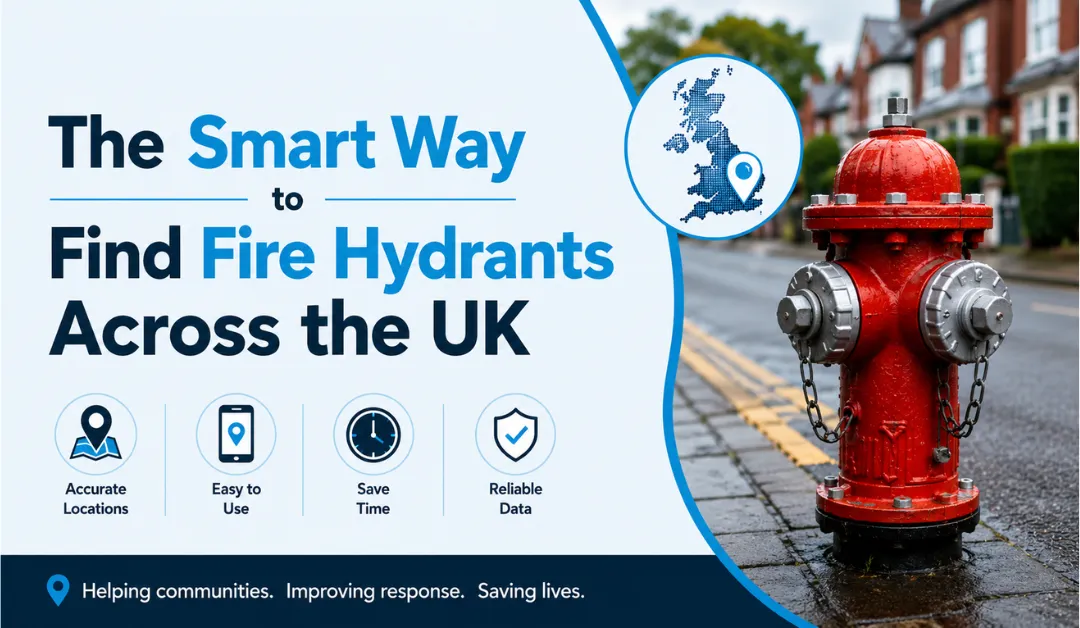
Knowing where the nearest fire hydrant is located might not seem important until an emergency happens. Whether you’re a homeowner, landlord, business owner or property developer, understanding where your closest hydrant is can help you prepare for emergencies, comply with building requirements, and make informed decisions about your property’s water infrastructure.
Many people assume that fire hydrants are easy to spot, but that isn’t always the case in the UK. Unlike the large above-ground hydrants commonly seen in other countries, most British fire hydrants are installed below ground beneath small cast iron covers. Unless you know what you’re looking for, you could walk past one every day without ever noticing it.
Fortunately, modern fire hydrant locator tools and official mapping services make it much easier to identify nearby hydrants. However, not every online map is accurate, and there are important legal and safety considerations you should understand before relying on them.
In this guide, we’ll explain how to locate a fire hydrant, where to find reliable UK fire hydrant locations, how hydrants are identified, and why knowing their position can also help when planning water main work around your property.
Why You Might Need to Locate a Fire Hydrant
Most people only think about fire hydrants during emergencies, but there are many everyday situations where knowing their location becomes useful.
For example, you may be:
- Planning a home extension or new driveway.
- Installing a new water supply pipe.
- Replacing an ageing water main.
- Carrying out landscaping work.
- Purchasing an older property.
- Managing commercial premises.
- Preparing a fire risk assessment.
In each of these situations, knowing the nearest hydrant location can help avoid unnecessary disruption and ensure underground infrastructure is properly protected.
Property developers and utility contractors regularly check hydrant locations before excavation begins because accidental damage to underground assets can result in significant repair costs and project delays.
What Does a Fire Hydrant Look Like in the UK?
One of the biggest misconceptions is that UK hydrants look like those seen in American films.
In reality, most hydrants across England are installed underground.
Instead of a large red pillar, you’ll usually find:
- A rectangular or oval cast iron cover.
- “FH” or “Fire Hydrant” cast into the lid.
- A nearby yellow hydrant indicator plate fixed to a wall, fence or post.
- Distance markings showing how far away the hydrant is.
The hydrant itself sits beneath the surface and connects directly to the local water main.
When firefighters arrive, they remove the cover, attach specialist equipment and connect directly to the underground water supply.
Because hydrants remain hidden until needed, many homeowners have one located outside their property without ever realising it.
Understanding Fire Hydrant Indicator Plates
The easiest way to identify a nearby hydrant is by looking for its indicator plate.
These bright yellow signs provide important information used by fire crews during emergencies.
A typical plate displays:
- The letters “FH”.
- The diameter of the connected water main.
- Horizontal distance to the hydrant.
- Vertical distance to the hydrant.
These measurements help firefighters locate the underground chamber within seconds, even at night or during poor weather.
Understanding these signs also helps contractors avoid damaging hydrants during excavation work.
What Is a Fire Hydrant Locator?
A fire hydrant locator is simply a mapping system or database that shows the position of registered hydrants.
Different organisations use different locator systems depending on their responsibilities.
Common examples include:
- Fire and Rescue Service mapping systems.
- Water company asset databases.
- Local authority utility records.
- Professional underground utility mapping software.
- Geographic Information System (GIS) databases.
Some publicly available mapping services also display hydrant locations, although coverage varies considerably between regions.
It’s important to remember that not every publicly available map is complete or regularly updated.
Professional contractors usually verify hydrant positions using official utility records before starting work.
How Accurate Are Online Fire Hydrant Maps?
Many websites claim to show every hydrant across the UK.
Unfortunately, that’s rarely the case.
Some maps rely on public contributions, while others use historical data that may no longer reflect current infrastructure.
Hydrants may have been:
- Relocated.
- Replaced.
- Decommissioned.
- Newly installed.
- Temporarily inaccessible.
Because of this, online maps should only be treated as a general guide.
If excavation work is planned near a suspected hydrant location, professional utility searches should always be carried out beforehand.
How to Locate a Fire Hydrant Near Your Property
Finding your nearest hydrant usually involves several simple steps.
Step 1: Check Outside Your Property
Walk around your property’s front boundary.
Look for:
- Yellow hydrant marker plates.
- Cast iron covers marked “FH”.
- Utility covers close to the pavement.
- Small access chambers near the road.
Many hydrants are located within a few metres of residential boundaries.
Step 2: Contact Your Local Water Company
Water companies maintain detailed records of underground water infrastructure.
Depending on your location, they may provide information about:
- Water mains.
- Fire hydrants.
- Valve chambers.
- Connection points.
They can also advise whether any planned maintenance work may affect nearby infrastructure.
Step 3: Contact Your Local Fire and Rescue Service
Some Fire and Rescue Services maintain hydrant registers for operational purposes.
Although complete databases aren’t always publicly available, they may provide guidance where appropriate, particularly for commercial premises or planning applications.
Step 4: Use Professional Utility Mapping
If you’re planning excavation, driveway construction or water main replacement, professional utility surveys provide the most reliable information.
Modern locating equipment combines:
- GPS mapping.
- Electromagnetic locating.
- Ground surveys.
- Utility records.
This significantly reduces the risk of accidental damage during construction.
Why Hydrant Locations Matter During Water Main Projects
Many homeowners don’t realise that fire hydrants connect directly to public water mains.
When replacing or upgrading your property’s water supply, contractors must consider nearby hydrants before excavation begins.
For example:
- Existing water mains must remain protected.
- Emergency access to hydrants cannot be obstructed.
- New pipework must comply with local regulations.
- Excavation routes may need adjustment.
This is one reason experienced water infrastructure specialists always assess surrounding underground assets before beginning work.
If you’re planning a replacement supply pipe, our guide to Water Main Replacement Sussex explains how professional planning helps avoid existing underground services while minimising disruption.
Are Fire Hydrants Connected to Your Property’s Water Supply?
No.
This is another common misunderstanding.
Fire hydrants connect directly to the public water distribution network rather than your private supply pipe.
Although they may appear close to your boundary, they remain part of the wider public water infrastructure.
This means homeowners cannot:
- Operate hydrants.
- Remove hydrant covers.
- Connect hoses.
- Alter hydrant chambers.
- Obstruct access.
Doing so may breach water regulations and could interfere with emergency response operations.
Can You Build Over a Fire Hydrant?
Generally, no.
Access to fire hydrants must remain available for emergency services at all times.
If you’re planning:
- A driveway extension.
- New boundary walls.
- Landscaping.
- Garden structures.
- Commercial developments.
You’ll need to ensure hydrant access remains unobstructed.
Professional site surveys identify these issues before construction begins, helping avoid expensive alterations later.
Who Is Responsible for Fire Hydrants in the UK?
Responsibility for fire hydrants in the UK is shared between different organisations, but homeowners generally do not have any maintenance responsibility.
In most cases, water companies own and maintain the underground water infrastructure that hydrants connect to. Fire and Rescue Services are responsible for inspecting and using hydrants during emergencies.
Water companies typically manage:
- Hydrant installation records.
- Repairs and maintenance.
- Connection to public water mains.
- Replacement of damaged infrastructure.
Fire and Rescue Services regularly inspect hydrants to ensure they can be accessed quickly when required.
If you notice a damaged hydrant cover, missing marker plate or a blocked access point near your property, you should report it rather than attempting to repair it yourself.
Why Are Fire Hydrant Locations Important for Homeowners?
Although hydrants are primarily designed for firefighters, their locations can affect property owners in several ways.
For example, before carrying out excavation work, you need to understand what is beneath the ground.
A homeowner installing a new driveway may unknowingly cover a hydrant chamber.
Someone replacing an old water supply pipe may dig close to a public main without knowing where important infrastructure is located.
Understanding nearby fire hydrant locations in the UK helps prevent accidental damage and ensures future maintenance remains possible.
This becomes particularly important in older neighbourhoods where underground infrastructure may have been installed decades ago, and records are not always straightforward.
Fire Hydrants and Property Development
For builders, developers and commercial property owners, checking hydrant locations is an essential part of planning.
Before starting construction work, professionals usually review:
- Existing underground utilities.
- Water main routes.
- Fire service access requirements.
- Hydrant positions.
- Proposed excavation areas.
This information helps determine whether plans need to be adjusted.
For example, a new driveway design may need to avoid placing heavy materials over a hydrant chamber.
A new extension may require confirmation that underground water infrastructure will not be affected.
Early planning avoids delays and prevents expensive changes after construction has already started.
How Fire Hydrants Support Fire Safety Planning
Fire hydrants form an important part of the UK’s emergency water supply network.
During a fire, firefighters need reliable access to large volumes of water quickly.
The location of nearby hydrants helps emergency teams:
- Establish water supply points.
- Connect firefighting equipment efficiently.
- Reduce response delays.
- Manage larger incidents.
For commercial properties, understanding nearby hydrant access may form part of a wider fire safety assessment.
Businesses with larger buildings, industrial units or high-risk environments often require detailed fire protection planning.
Difference Between Fire Hydrants and Private Water Systems
A fire hydrant is part of the public water network.
It is different from private systems such as:
- Garden taps.
- Private water storage tanks.
- Sprinkler systems.
- Internal fire suppression equipment.
A hydrant receives water directly from public mains infrastructure.
Your home’s water supply, on the other hand, travels through a separate private supply pipe after connecting from the public network.
This distinction matters because problems affecting your home’s water pressure or supply are usually unrelated to the nearest hydrant.
If you are investigating issues with your property’s incoming water supply, understanding your underground pipe route is important. You can learn more about how to find water pipes underground before carrying out any work.
Can Homeowners Use Fire Hydrants?
No.
Fire hydrants are not designed for public use.
They must only be accessed by authorised personnel such as:
- Fire and Rescue Services.
- Water company engineers.
- Approved contractors.
Opening or interfering with a hydrant can create serious problems, including:
- Reduced emergency water availability.
- Damage to underground infrastructure.
- Contamination risks.
- Legal consequences.
If you require additional water supply for property work, there are approved methods available through your water supplier or contractor.
A fire hydrant should never be treated as a convenient water source.
Common Mistakes People Make When Searching for Fire Hydrant Locations
Many homeowners make assumptions that can lead to confusion.
Assuming the Nearest Hydrant Is Always Visible
Because most UK hydrants are underground, you may not see obvious equipment nearby.
The indicator plate may be attached several metres away from the actual chamber.
The markings on the plate guide emergency services to the exact location.
Relying Only on Online Maps
Online maps can be useful, but they may contain outdated information.
Infrastructure changes over time, meaning a hydrant shown on an old database may no longer represent the current situation.
For important projects, always confirm information through professional channels.
Moving or Covering Hydrant Signs
During landscaping or property improvements, some homeowners accidentally cover indicator plates or access covers.
This can create serious problems during emergencies.
Before altering walls, fences or driveways, check whether hydrant markers are nearby.
What Should You Do If You Find a Damaged Fire Hydrant?
If you notice a problem with a hydrant near your property, do not attempt repairs yourself.
Examples of issues that should be reported include:
- Broken hydrant covers.
- Missing marker plates.
- Flooding around a hydrant chamber.
- Damaged access points.
- Construction materials blocking access.
Contact your local water company or Fire and Rescue Service for guidance.
Providing details such as the location, nearby landmarks, and photographs can help them respond more efficiently.
Fire Hydrant Access During Water Main Repairs
During water main repairs or upgrades, contractors must consider nearby hydrants carefully.
Temporary work areas should not prevent emergency access.
Professional contractors plan projects to ensure:
- Hydrant access remains available.
- Water supplies remain protected.
- Excavation avoids unnecessary risks.
- Existing infrastructure is properly managed.
This is especially important during larger underground pipe projects where multiple services may run beneath roads and pavements.
Modern trenchless techniques can reduce surface disruption during pipe installation.
For properties requiring new underground water connections, professional Moling Services Sussex can provide a lower-disruption alternative to traditional excavation methods.
Fire Hydrant Location Checklist
If you need to identify a hydrant near your property, follow this simple checklist:
| Step | What To Do |
| 1 | Look for yellow hydrant indicator plates near your property |
| 2 | Check pavement and boundary areas for covers marked FH |
| 3 | Contact your local water company for official information |
| 4 | Arrange a utility survey before major excavation work |
| 5 | Keep hydrant access clear after landscaping or construction |
This approach provides a safer and more reliable way to identify nearby hydrants.
Frequently Asked Questions
How do I find the nearest fire hydrant?
You can locate the nearest fire hydrant by checking for yellow hydrant indicator plates, underground covers marked FH, contacting your local water company or using professional utility mapping services.
Are fire hydrant locations public in the UK?
Some information about UK fire hydrant locations may be available through local authorities, water companies or specialist mapping services. However, complete operational records are not always publicly accessible.
Are fire hydrants connected to my home’s water supply?
No. Fire hydrants connect to the public water network and are separate from your private household supply pipe.
Can I use a fire hydrant for garden watering?
No. Fire hydrants are emergency infrastructure and can only be accessed by authorised organisations.
How far away is a typical fire hydrant from a property?
There is no fixed distance. Hydrant spacing depends on local planning requirements, population density, road layout and water network design.
Who maintains fire hydrants in England?
Water companies generally maintain the physical hydrant infrastructure, while Fire and Rescue Services inspect and use hydrants during emergencies.
What does FH mean on a pavement cover?
FH stands for Fire Hydrant. It indicates that an underground hydrant is located beneath or near that cover.
Final Thoughts
Knowing how to use a fire hydrant locator can provide valuable information for homeowners, landlords, businesses, and anyone planning work around their property.
Although fire hydrants are mainly associated with emergency services, their locations matter whenever underground work is planned. Identifying nearby hydrants helps protect important infrastructure, prevents accidental damage and ensures emergency access remains available.
The safest way to locate a fire hydrant is by combining visible indicators with reliable information from water companies, local authorities or professional utility surveys.
Never assume an underground service is exactly where you expect it to be. Before digging, always confirm what exists below the surface.
Proper planning protects your property, supports emergency services and helps maintain the UK’s essential water infrastructure for everyone.