
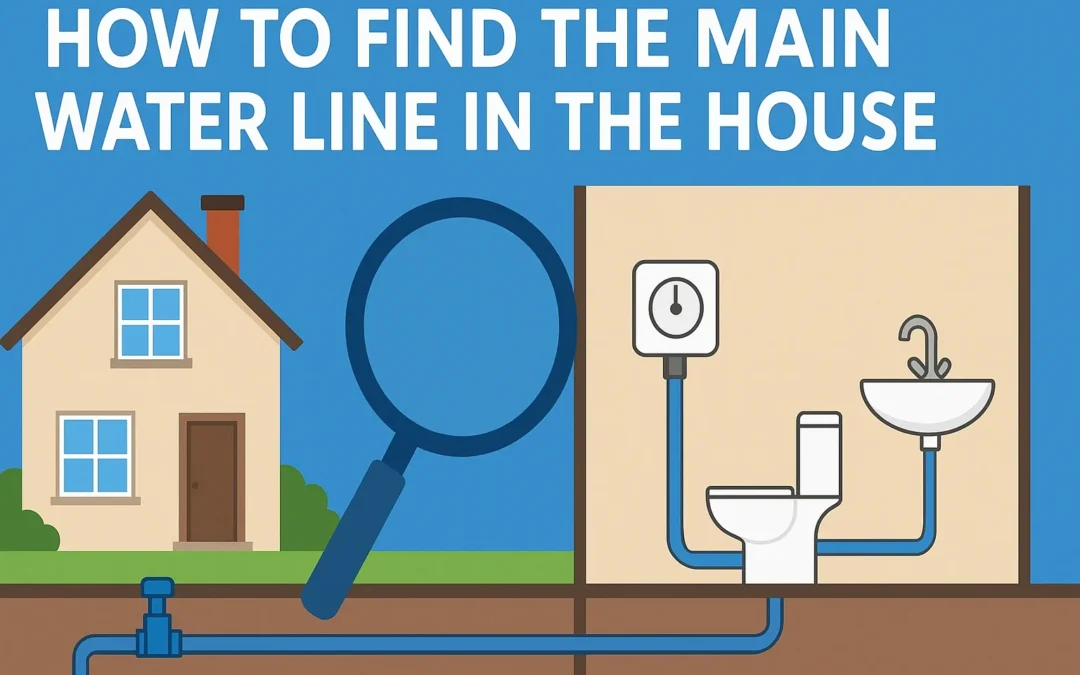
Let’s be honest. No one gets up eager to determine where his main water line is. It is among those things that people only think about when everything goes wrong. A pipe bursts. A leak appears. Every second is counted suddenly and you also find that you do not even know where the water is actually coming.
Finding out the location of the main water line in the UK is not a luxury especially in case you live in the UK. It is a necessity. And in such areas as West Sussex, where the houses are between half a century old cottages and new estates, each building conceals its water supply in some fashion or other. Some are obvious. Some are creative. And others seem to be the work of a designer who thoroughly despised prospective house owners.
You are going to know all in this guide. The way your water line gets in the house. How to follow it. How to shut it off fast. And most of all, how to prevent the panic caused by the falling of the water at all in the wrong place.
The guide is designed specifically to Sussex home owners but the information is relevant to properties in the whole of the UK. And having more than 45 years experience in Sussex Water Mains we have had every kind of layout of pipes under the sun. Thus it is not a purely abstract explanation. This is not theory, it is knowledge.
We will start with the simplest question that can be asked.
What Is Your Principal Water Line?
First, before we proceed to search for it, we should ensure that we are talking about the right thing.
The primary water line or the underground pipe is the one that supplies you with clean, consumable water the supply of which is provided by your local water authority. It is not the pipe in your sink. Not the pipe that feeds your boiler. This is the one which nourishes all.
After the water reaches your house, it will pass through your internal stop tap, inseparable into various branches and flow around your house. But all this starts at one point of entry.
Knowing where that point is, you know immediately two things:
- Where the water supply into the house is.
- Where you can cut off all the water in case of need.
And that will save you hundreds or even thousands of pounds in damage.
Why You Have to Know This Before You Need It?
Imagine this.
One of the pipes breaks behind the washing machine. Your kitchen is being filled up with water. You actually go to turn everything off in panic. However, you are not aware of the location of the main shut off valve. You open cupboards. You look behind the toilet. You go outside. You panic harder. The water continues to flow with every minute.
It is at this point that most people determine to know about their water line. But by then, it is too late.
You know where to find the main water line in the UK, and that is a matter of control.
You make a single step, as opposed to panicking. Turn one valve. And the issue is immediately terminated.
You are absolutely in need of this knowledge in the event that you own your home. Your landlord is meant to have informed you, which is not the case in many instances, as you rent. So you still need to know.
The Two Places You have to Find
In order to know your water supply system completely, you should locate the following:
- External stop tap (mostly in the street)
- The internal stop tap (in your house)
Both you know, and you know it all. You have knowledge on how the water flows into your property, how to manage it, and how to stop it.
Now we shall look at the real process.
Step One: The Location of the Main water line UK outside the house
There is no sure way to begin than this. The outer stop tap will be attached to the primary water pipe along the street. Then a smaller pipe leads off to your house.
Here is how to find it.
Search for a sort of rectangular or round cover outside.
This can be found in most properties in one of the following places:
Approximately on the adjacent land of your place of residence.
On the sidewalk of your house.
Next to your driveway
In the garden of your front near the footpath.
Lift the cover. There will be a little room in there with a tap or valve or lever. This is the first clue. The pipe which leaves this room leads directly to your house. By taking that direction in your mind, you are able to know which general direction the pipe will be entering your property.
This is by which you know the external origin. But we must have the inside entry.
Step Two: Continuing the Line to Your House
In the UK, the water pipes take the course of minimum resistance. They do not follow convoluted paths when they are not compelled. The way once you find the external stop tap, use a straight line as a way into your house.
Common entry points include:
- Under the front bay window
- Via the front wall towards the porch.
- Using the floor at the front door.
- Below the kitchen window
- Straight into a utility room
In older homes the entrance could be deep down through the floorboard or cupboard. In the present-day homes, it tends to be more convenient to locate since the entrance is well oriented close to the kitchen or utility room.
But there is nothing to fret about it being that your house is not typical. Let’s go deeper.
Step Three: Locating the Main Water Line Entry to the House
This has extremely foreseeable locales. The majority of the British houses share the same logic of plumbing.
- The most popular are the following locations.
Under the kitchen sink
This is most probable in newer properties.
Open the cupboard, and gazed at the back wall or at the bottom floor. You can see that there is a pipe that emerges out of the ground and a valve that is attached to it. When you turn off the valve cutting off water to the whole house, then you have just located the inside entrance.
Near the front door
Other houses position the entry of the water just in front of the entrance hall. Partly concealed in a little panel.
Check:
- Cupboards
- Storage compartments
- Service panels
Under the stairs
Check corners and skirting area in case you have an under stair cupboard. The supply line brought up many older houses.
In the utility room
Where your washing machine, boiler or softener is situated within a utility room then the primary supply is usually nearby.
In the downstairs toilet
Certain terraced houses have the internal stop tap mounted in the background behind the toilet, or under the small hand basin.
In basements (if you have one)
The basement entries can be detected very easily since the pipe will be visible along the wall or through the concrete floor.
There is still a way of finding it should you not.
Step Four: Follow the Noise
This is a very easy method that is quite effective.
Turn on a tap inside the home.
Go out and hear close to the boundary valve.
Then take a leisurely stroll on the way to your house.
It is possible to hear the water flowing in the pipe at times.
When you enter a particular room and the flow of water is more pronounced, it is very probable that that is the entrance point.
This technique is effective in scenarios that have pipes that are shallow or near the floor.
Step Five: Assault with the Pressure Method
This is one more trick that specialists resort to.
Switch off the inside stop tap (where it is there).
Try turning on a tap inside.
When water does not come, you have the right tap.
When water continues to flow that is not the primary valve.
This assists you in determining the right entry point in the event of observing more than two pipes.
Step 6: Where Is The Main Water Shut off Valve?
It is the question that nearly any homeowner asks at a certain moment.
The solution: The main shut off valve is nearly always at the very point to which the internal water supply of the home pours.
Here is how to identify it:
- It is the valve that closes the water supply in the whole house.
- This is commonly the initial valve when the pipe gets into the property.
- It usually appears to be older or more heavy than other valves.
- It is normally located beneath the ground or it may be close to the floorboard.
In case you are wondering where the main water shut off valve, just follow the outside-inside path. When you locate the point of entry, the shut off valve is normally within reach.
Step Seven: What Do You Do with Your Water Main? Is your house old, renovated or unusual?
Old British properties can be very random as most of them have been expanded, changed or even refurbished over time.
The following are the uncommon locations in which we have encountered water mains in our labours in West Sussex:
- Behind false walls
- Inside old airing cupboards
- Under floorboards on the corridors.
- Behind kitchen units fitted much later than the original plumbing.
- In rear extensions
- Within garages turned into residences.
The layout of the pipes may not adhere to the current regulations in case your house is more than 40 years old. In such situations, one can use the following indications:
Look for old lead pipework
Follow the boiler cold feedback.
Check at the original section of the house and not the extension.
The older ones are fitted with lead pipe of the original type, being soft, grey and slightly pliable. When you happen to find that, you have certainly found the main supply, and you may consider lead water pipe replacement if necessary.
Step Eight: What do you do when you can still not find it?
It is no disgrace to think that searching is like a treasure hunt without the treasure. Most of the owners of homes cannot locate their pipes since they are covered, encased, or covered with tiles or concealed behind the contemporary decorations.
This is extremely common.
At Sussex Water Mains, it is the same thing with the homeowners calling us a week with the same question:
I have been living here all my years and I never knew where my water comes in.
We apply the use of specialist tools such as pipe locators, listening tools as well as tracers to trace the route underground without excavating. This allows us to find the precise point of entry without breaking up your flooring and walls.
Do not feel frustrated. Most of the houses actually force a normal person to search his home alone.
Step Nine: Why It Matters More than You Think?
Being aware of the point of water main entrance into your house guard you against:
- Unexpected leaks
- Frozen pipes
- Burst mains
- Water damage
- Unnecessary flooding
- Repair delays
- The problems with claims in insurance.
When you are unable to turn off your water, in case of an emergency, the damage will spread very fast. The sooner you are aware of the location of the valve the better place your home will be.
Step Number 10: When You Found It Do This at Once
Once you have found your main water line and a shut off valve, do the following three significant things.
Label it clearly
Make use of a waterproof marker or a tag. Write: Main Water Valve.
Test it every six months
Unused valves tend to become stuck. To guarantee that it remains functional, turn it after every couple of months.
Keep the area accessible
Do not compose cupboards or cover it up with heavy storage boxes. Convenience it at all times.
The Sussex Angle
The first step is to find your water main. But what then happens when it is the pipe itself?
The specialisation at Sussex Water Mains is in Lancing, West Sussex:
- Water main repairs
- Lead pipe replacement
- Leak detection
- Underground pipe tracing
- Installations that do not require you to dig up your garden.
- New supply connections
- Burst pipe emergencies
Having upwards of 45 years of experience we know the land, the soil, the type of property and the underground planning of Sussex better than anyone. Homeowners are customers when they lose track of their water main, or when their pipes require repair under their property.
We offer fast, clean, and non-mess services through contemporary moling contractors west sussex. No trenches. And we do not transform your garden into a construction site, ensuring minimal interruption.
Conclusion
One of the most important yet easiest things a homeowner in the UK should know is to find his or her water main. It protects your home. It trains you on how to act in case of an emergency. It saves money. And it puts your water at your mercy.
The reason why you should find your main water line today, regardless of whether you are in West Sussex or any other part of the UK, is the matter of a few minutes. Test the valve. Be aware of the point of entry of the pipe in your house. Since at one of these moments the unforeseen strikes, these few minutes will mean everything.
Should you require assistance in finding, repairing or replacing your water main Sussex Water Mains is always there with prompt clean no dig solutions that are relied upon in Sussex.